August 2025 - Present

August 2025 - Present

August 2025 - Present

build and expand your personal style
overview

overview

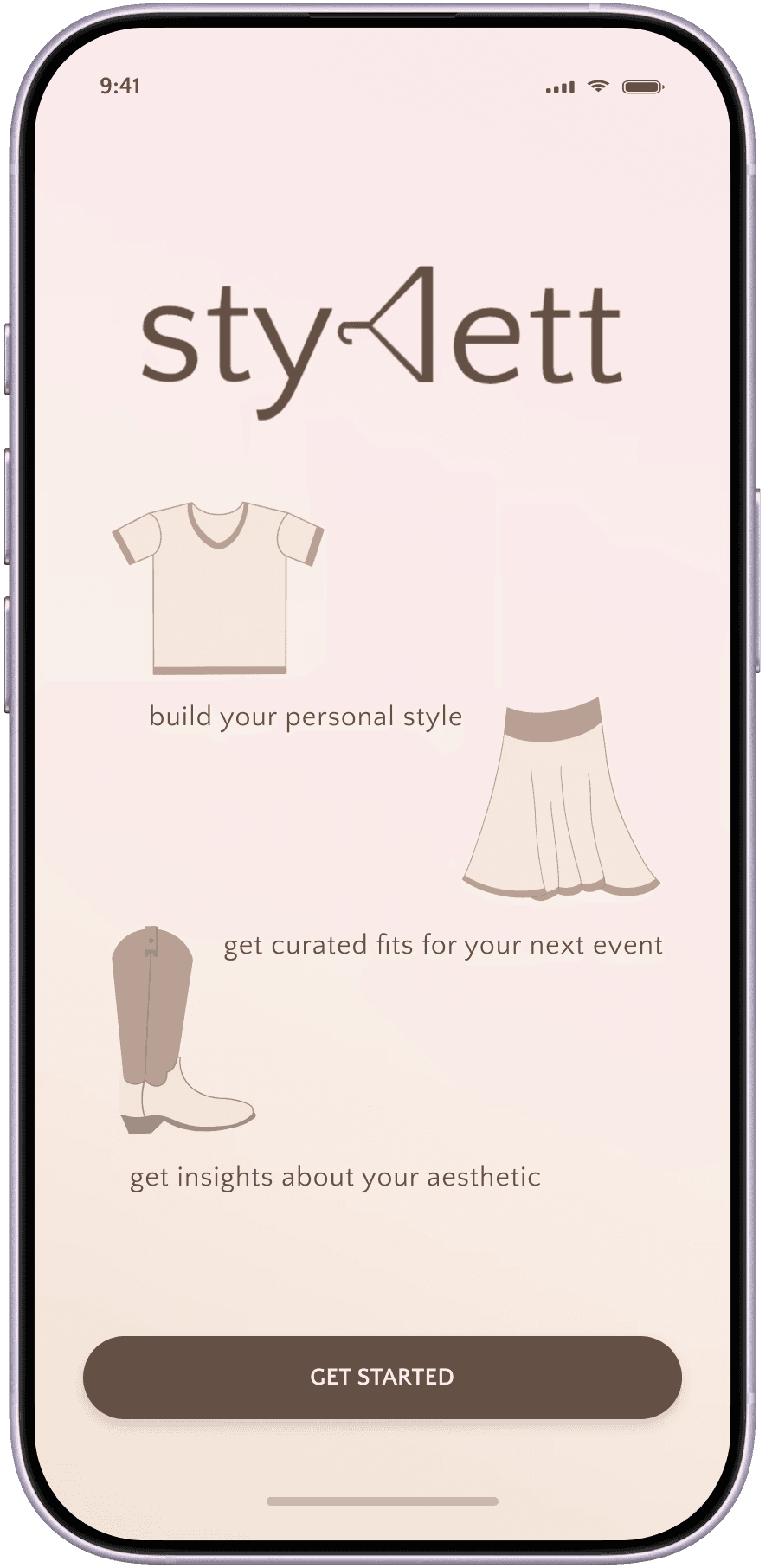
stylett is an AI-powered mobile app that helps users

(1) recognize and define their personal style and aesthetic

(2) recommends fits in a gamified manner based off their style profile.

stylett is an AI-powered mobile app that helps users

(1) recognize and define their personal style and aesthetic

(2) recommends fits in a gamified manner based off their style profile.

tools

tools

Figma, Figjam, Claude Design, Claude Code

Figma, Figjam, Claude Design, Claude Code

status

Style Space designed and built. Recommendation engine in progress.

Style Space designed and built. Recommendation engine in progress.

user surveys

user surveys

I ran a user survey with a set of women between the ages of 22-29 to get an understanding of how Stylett could aid with uncertainty surrounding one's aesthetic as well as to gather information about how people would describe their style, methods of picking out outfits for specific events, and their pain points with understanding their identity through their clothes.

I ran a user survey with a set of women between the ages of 22-29 to get an understanding of how Stylett could aid with uncertainty surrounding one's aesthetic as well as to gather information about how people would describe their style, methods of picking out outfits for specific events, and their pain points with understanding their identity through their clothes.

I used Claude AI to design the survey to extract structured data and synthesize the responses into actionable insights:

I used Claude AI to design the survey to extract structured data and synthesize the responses into actionable insights:

key findings

key findings

New events are dramatically harder than familiar ones

New events are dramatically harder than familiar ones

Have a wardrobe, but most don’t know what to do with it.

Have a wardrobe, but most don’t know what to do with it.

Style matters but they can't describe it.

Style matters but they can't describe it.

Some styles were described in a narrative way others with clear labels (floral, feminine)

Some styles were described in a narrative way others with clear labels (floral, feminine)

People leaning towards a moodboard for patterns that they don’t see themselves

People leaning towards a moodboard for patterns that they don’t see themselves

pain points

pain points

Miscalculation of how formal to be at an event

Miscalculation of how formal to be at an event

Can’t translate their wardrobe into outfits

Can’t translate their wardrobe into outfits

Feel lost about reading the event than knowing themselves

Feel lost about reading the event than knowing themselves

Based off these insights, I was able to collect a set of user goals and needs to start building Stylett:

Based off these insights, I was able to collect a set of user goals and needs to start building Stylett:

user goals

user goals

Get formality / vibe right for a specific event without having to ask someone or Google it

Get formality / vibe right for a specific event without having to ask someone or Google it

Make use of what they already own rather than buying new things

Make use of what they already own rather than buying new things

Have their style recognized and named back to them accurately

Have their style recognized and named back to them accurately

user needs

user needs

A way to translate “I know what I like” into “I know what works here”

A way to translate “I know what I like” into “I know what works here”

Style vocab that feels personal, not generic

Style vocab that feels personal, not generic

Body-type aware recommendations

Body-type aware recommendations

outcome

outcome

In conclusion, the user survey allowed me to narrow the app down to two major use cases:

In conclusion, the user survey allowed me to narrow the app down to two major use cases:

"Style Space", where the user can interact with and receive AI-powered and readable insights about their aesthetic.

"Style Space", where the user can interact with and receive AI-powered and readable insights about their aesthetic.

&

&

"New Event, New Fit", a space where users describe an event they're attending and receive outfit recommendations tailored to both the occasion and their aesthetic.

onboarding wireframing

onboarding wireframing

I started off with sketching out a basic user flow for the onboarding experience and the homepage ("Your Aesthetic Mirror")

I started off with sketching out a basic user flow for the onboarding experience and the homepage ("Your Aesthetic Mirror")

The onboarding flow is simple: the user

  1. Uploads 5-10 outfits,

  2. Describes their style in less than 1000 characters, and

  3. Answers a series of questions to tighten up the user's profile, such as:

    1. Favorite colors

    2. Jewelry metal preferences

    3. Shoes preference

    4. Favorite seasons

The onboarding flow is simple: the user

  1. Uploads 5-10 outfits,

  2. Describes their style in less than 1000 characters, and

  3. Answers a series of questions to tighten up the user's profile, such as:

    1. Favorite colors

    2. Jewelry metal preferences

    3. Shoes preference

    4. Favorite seasons

Architecture

Architecture

Next up was creating a model architecture that Stylett would use to drive the user's aesthetic profile and recommendation engine.

There were many iterations done on architecture using Claude, using one-shot prompting. As an input example, I wrote up a description of my own style, going as specific as possible, as well as provided a set of outfit photos.

Next up was creating a model architecture that Stylett would use to drive the user's aesthetic profile and recommendation engine.

There were many iterations done on architecture using Claude, using one-shot prompting. As an input example, I wrote up a description of my own style, going as specific as possible, as well as provided a set of outfit photos.

description input example

description input example

my personal style aesthetic: "chill, a bit girly, more plain colors not too many patterns."

my personal style aesthetic: "chill, a bit girly, more plain colors not too many patterns."

fall - sweaters, tuck in, turtleneck shirts, tights with skirt and black/brown tall boots

fall - sweaters, tuck in, turtleneck shirts, tights with skirt and black/brown tall boots

summer - sleeveless tops, tube tops trying out to wear more skirts and floral dresses

summer - sleeveless tops, tube tops trying out to wear more skirts and floral dresses

winter - want to explore more, but always resort to leather jacket or puffy jacket with shirt or sweater underneath and jeans occasionally scarf but don’t really know how to style it half the time

winter - want to explore more, but always resort to leather jacket or puffy jacket with shirt or sweater underneath and jeans occasionally scarf but don’t really know how to style it half the time

spring - want to explore more, but end up wearing summer clothes. want to explore more floor length flowery dresses

Using Claude to iterate on this model architecture with this input along with the user survey results, I created a structure that cleanly stores the user's information and draws it to recommend outfits:

Using Claude to iterate on this model architecture with this input along with the user survey results, I created a structure that cleanly stores the user's information and draws it to recommend outfits:

model architecture

model architecture

The first model is the facets model, which stores the basic fashion elements that the user exhibits (taken from the photos and description. Some of these elements include:

The first model is the facets model, which stores the basic fashion elements that the user exhibits (taken from the photos and description. Some of these elements include:

silhouette

silhouette

base color

base color

accent color

accent color

pattern

pattern

neckline

neckline

jewelry

jewelry

The second model is the style profile model, which draws on the facets model to create a profile of the user's style and aesthetic. It includes:

The second model is the style profile model, which draws on the facets model to create a profile of the user's style and aesthetic. It includes:

identity and top aesthetics

identity and top aesthetics

contexts

contexts

missing information (gaps)

missing information (gaps)

explorations

explorations

homepage (Style Space) wireframing

homepage (Style Space) wireframing

Once I had the model finalized, I began creating an information architecture and wireframes for the homepage, which would essentially be the user's Style Space.

Once I had the model finalized, I began creating an information architecture and wireframes for the homepage, which would essentially be the user's Style Space.

information architecture

information architecture

IDENTITY MIRROR

Top three style attributes of the user, in their own words

Top aesthetics with scores calculated like so:

  • Match facets against archetype presets.

  • Weight by confidence

  • Score each independently out of 100, normalized later.

Iteration #1

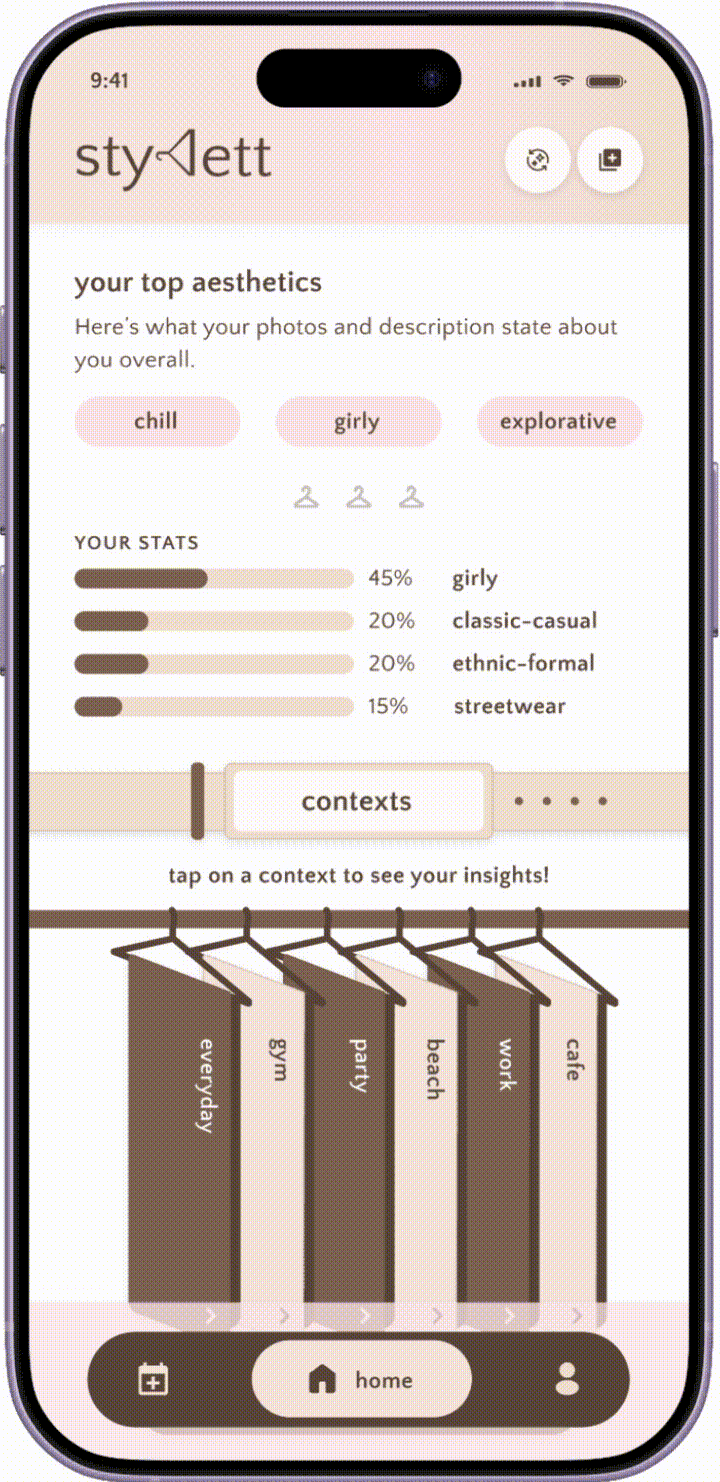
This section of the Style Space was pretty intuitive from the get-go. The user would clearly be able to see their top three style attributes extracted from their photos and/or written description. Underneath, they could see their "aesthetic stats" - in a view similar to a bar graph, pie chart, or progress bar-like visuals.

This section of the Style Space was pretty intuitive from the get-go. The user would clearly be able to see their top three style attributes extracted from their photos and/or written description. Underneath, they could see their "aesthetic stats" - in a view similar to a bar graph, pie chart, or progress bar-like visuals.

Iteration #2

I wanted the identity mirror to visually look like a mirror, so in the final iteration for this section I added a basic structure for how this section would look like in the lo-fidelty wireframe.

CONTEXT CARDS

Iteration #1

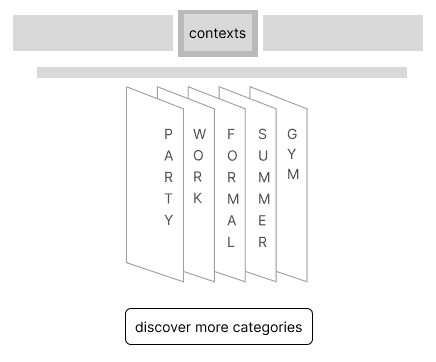
Each context card would contain insights about the user's style for this specific context, e.g. what a user's style looks like for a night party.

The context cards needed to be very clearly displayed & clickable to reveal specific insights about each. Here were the first set of iterations for the context card section:

Essentially, the idea was the the user could click on a context card, such as "Party", and see their photos in this context they uploaded, their level of confidence (if illustrated in the description), plus all of the aesthetics (e.g. ethnic-formal, romantic) that make up this context, and lastly all the seasons that the user wears this context in.

The problem with this iteration was that it was just a view, and no clear actions if the user wanted to take any.

Iteration #2

After doing some iterations on the model, the final structure of a context would display the user's photos, outfit parts, confidence level, and the aesthetic ratio for each relevant season. This section would be clearly for insight display, and they would be able to take actions in the next section - "Gaps".

LOOSE THREADS

Top three style attributes of the user, in their own words

  • Top aesthetics with scores calculated like so:

    • Match facets against archetype presets.

    • Weight by confidence

    • Score each independently out of 100, normalized later.

Iterations

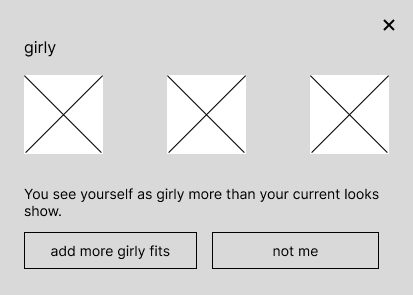
The gap cards originally only displayed differences in the user's descriptions and photos. For example, in some people's responses (including mine), a couple of described aesthetics didn't match up with the user's photos. So, in order to include those mismatches, I created gap cards

Here are some examples of those gaps:
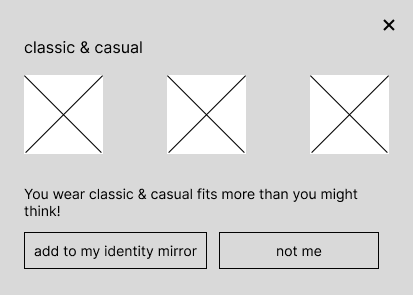
The main problem with these gap cards is that there was no clear distinction between an "insight" (which would displayed in the context cards), and what would qualify as a "gap." For example, if a user didn't have a mismatch between their descriptions and their photos, would we not have any gaps?

Another problem is that there were too many actions that the user could take, which could lead to cognitive overload.

This would be re-explored in the next iteration, both on the model and the wireframes.

Iteration #2

After doing some iterations on the model, the final structure of the missing elements in their style profile would be based on if a context was missing a fit / aesthetic ratio for a relevant season.

For example, the "everyday" context can have aesthetic ratios for summer, fall, and spring, but not for winter - so this would be a card under the gaps section, which I decided to name "Loose Threads."

Clicking on a card would reveal an insight about that gap (an AI-generated message based on the detected gap), and allow the user to upload a fit specific to that. This would trigger a reload of the homepage after the analysis is done.

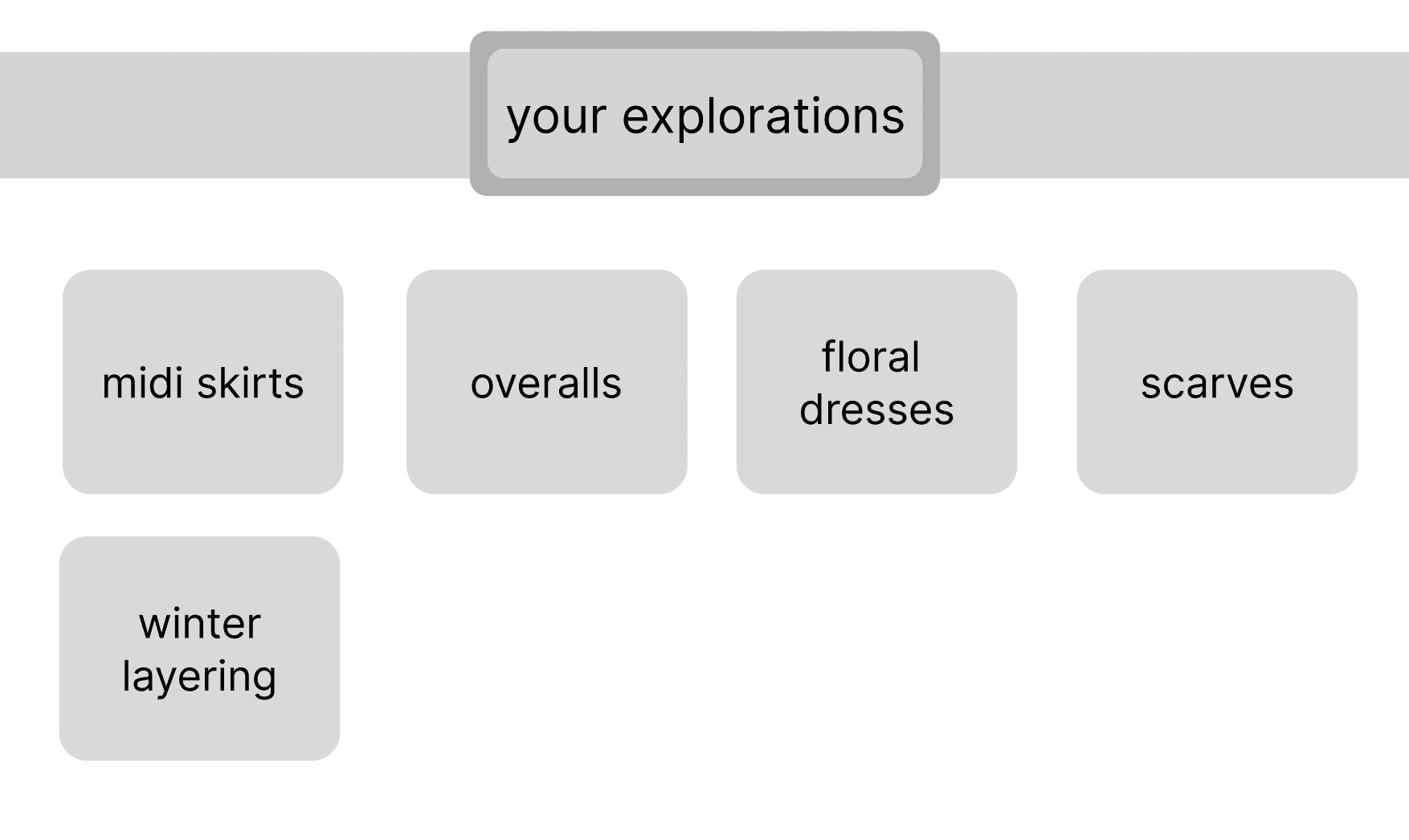
EXPLORATIONS: Aspirations & Frictions

A set of cards that would be displayed to the user consisting of all the outfits / clothing they would want to try out, divided into aspirations and frictions.

  • An aspiration would be something that the user would want to explore, "I want to wear more mid-thigh length skirts.

  • A friction would be something that a user is struggling to style, e.g. "I'm not sure how to style a scarf"
final homepage wireframe

final homepage wireframe

Kavya Verma

Contact

kavya.verma@gmail.com

Kavya Verma

Contact

kavya.verma@gmail.com

Kavya Verma

Contact

kavya.verma@gmail.com